
Oklahoma cannabis businesses have until November 29, 2026 to build a DEA compliant supply chain, and the rules for doing it are still unclear. As Oklahoma cannabis business owners ourselves, we are reading the same guidance you are, and we have more questions than answers.
This article lays out what the DEA has actually said, how each license type appears to fit, and the questions no agency has clearly answered yet. Genius Buds is not giving final answers here. We are waiting on the DEA, OMMA, and OBNDD to provide clear direction, and we will update this page as soon as they do.
What the DEA announced on October 30
On October 30, 2026, the DEA released guidance for medical marijuana businesses that applied for federal registration after medical cannabis moved to Schedule III. It set a November 29, 2026 deadline for timely applicants to verify every trading partner and establish a compliant supply chain (National Law Review).
The key points:
Closed supply chain. Timely applicants may only buy from and sell to other timely applicants or DEA registrants. A state license alone is not enough (Kocot Law).
Real consequences. Dealing with an ineligible business could be grounds to deny a pending application or revoke a registration.
Existing inventory. Timely dispensary and distributor applicants may keep handling inventory acquired before October 30, but this relief does not clearly extend to manufacturers.
Not binding law. The guidance itself says it does not have the force of law, yet businesses are expected to follow it.
At the same time, the DEA issued its first federal registrations to more than 900 dispensaries in seven states. Oklahoma was not among them (MMJ Daily).
Who counts as a DEA timely applicant
A timely applicant is a business that submitted a complete DEA registration application, including the fee, between April 28 and June 26, 2026. Timely applicants may keep operating under their state license while the DEA reviews their application.
That protection ends if the application is withdrawn, denied by final order, or the state license lapses. Businesses that filed after June 26, or never filed, get no grace period. They cannot handle medical cannabis federally until the DEA approves their registration.
Oklahoma adds its own requirement. The Oklahoma Bureau of Narcotics and Dangerous Drugs Control (OBNDD) requires growers, processors, and transporters to obtain DEA registration, and says it will not take enforcement action before January 1, 2027. After that, penalties can include revocation of OBNDD registrations (Marijuana Moment).
Who can work with whom under the DEA rules
The DEA's medical marijuana rule is written as a three tier system: manufacturers, distributors, and dispensers. Under 21 CFR 1301.13(k), manufacturers may cultivate, produce, process, package, label, and transfer marijuana to registered distributors or other registered manufacturers (eCFR; WeedPress).
Here is how each DEA registration type appears to line up with Oklahoma licenses, based on our reading of the rules:
DEA registration type
Oklahoma licenses it covers
Appears able to receive from
Appears able to transfer to
Manufacturer
Growers and processors
Other manufacturers
Other manufacturers and distributors
Distributor
Any business that filed a distributor application
Manufacturers
Dispensers and other distributors
Dispenser
Dispensaries
Distributors
Patients
Analytical lab
Testing labs
Samples under strict conditions
Cannot return product to the business
One business can hold more than one registration type, and each location needs its own registration. Treat this table as our interpretation, not an official DEA chart.
The questions Oklahoma operators still need answered
The biggest problem is not the deadline. It is that two sets of federal rules seem to point in different directions, and no agency has clarified which one controls.
Can a grower or processor sell straight to a dispensary?
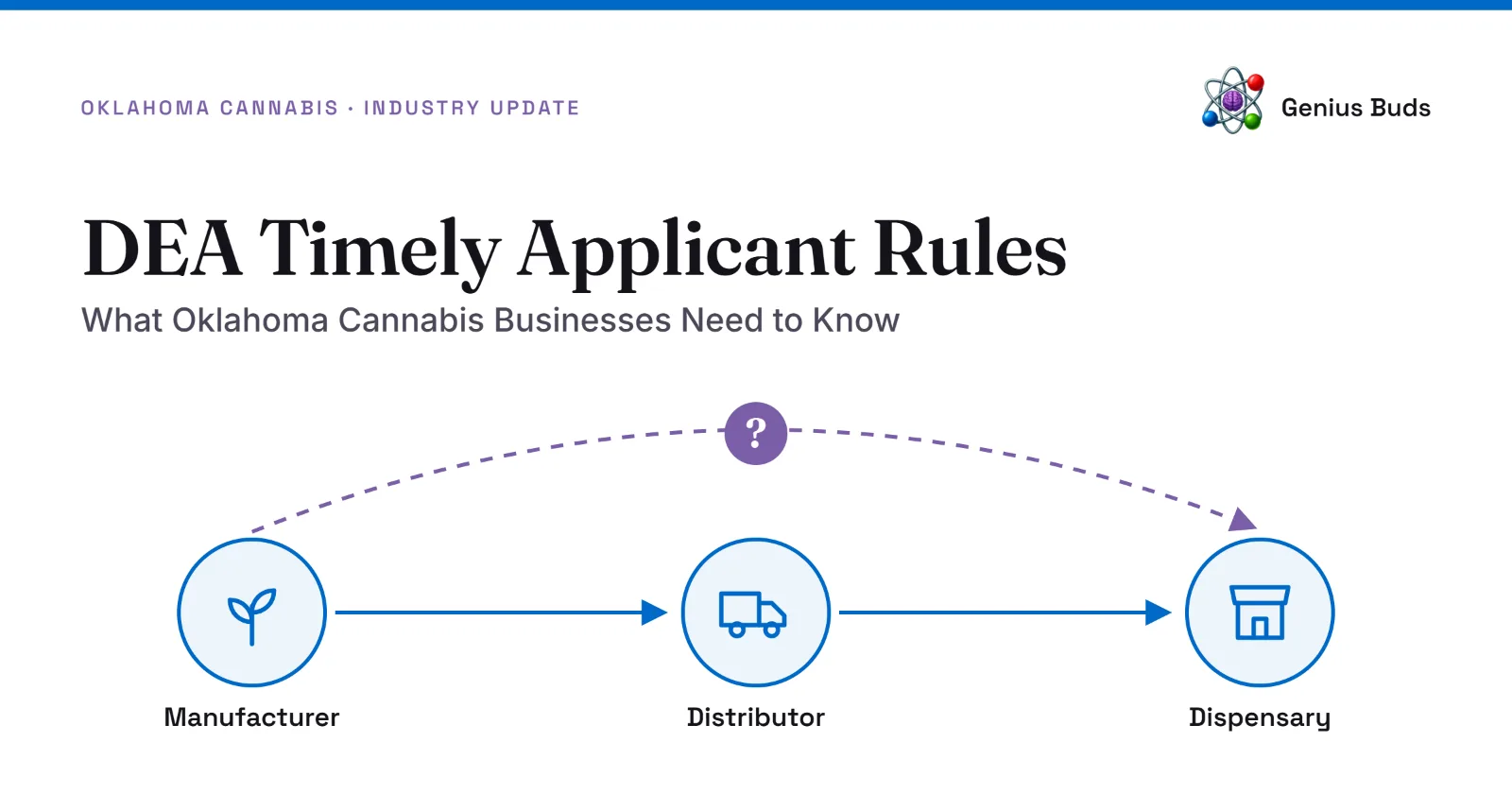
The general DEA rule, 21 CFR 1301.13(e), says a manufacturer registration allows distribution of the substances it manufactures. The newer medical marijuana rule lists only distributors and other manufacturers as recipients of manufacturer transfers. The October 30 guidance gives its example chain as manufacturer to distributor to dispensary, and never directly says whether a manufacturer can skip the distributor. Even legal analysts tracking this say the DEA has not answered it (WeedPress).
For Oklahoma growers and processors holding only a manufacturer application, this is the question that decides how they can sell.
Does a transporter count as a distributor?
Selling product and physically moving it are two different things. Federal law generally exempts common carriers from registering when they only move product in the normal course of business. A transporter that buys and resells product, however, is acting as a distributor. Oklahoma has only 49 licensed transporters, according to OMMA data from August 2026, and OBNDD requires transporters to obtain DEA registration (The Cannabis Business Advisors).
How do we verify trading partners?
The DEA asks businesses to collect each partner's submission confirmation, check its document control number on the DEA website, and confirm its state license is active. In practice, verification is harder than it sounds:
No business names. The DEA timely applicant list shows control numbers by state and type, not business names, so every partner has to provide its own number.
Misleading dates. The DEA application search shows a received date rather than the submission date, which can make a timely applicant look late.
A moving list. Entries drop off when registrations are granted, withdrawn, or denied, so a business missing from the list may already be registered (Kocot Law).
Mixed messages. OMMA has said it has received very few answers, and has encouraged licensees to seek professional counsel.
What this means for Oklahoma cannabis businesses
Oklahoma is a medical only market, which spares it the dual use uncertainty facing states where most licenses cover both medical and adult use (Foley Hoag). But the scale of the market makes the closed supply chain hard to build.
OMMA counted 1,323 dispensaries, 1,801 growers, and 587 processors in August 2026. The DEA timely applicant list shows far fewer Oklahoma entries than that, which suggests hundreds of Oklahoma businesses may fall outside the timely applicant pool. Every grower, processor, and dispensary now has to figure out which of its partners still qualify.
What we are doing while we wait
Until the DEA, OMMA, or OBNDD gives clear direction, these are the steps we are taking as Oklahoma operators. They are not legal advice, just a practical way to stay organized:
Confirm our own status. Keep the DEA submission confirmation and document control number on file.
Collect partner numbers. Ask every dispensary, transporter, and supplier for its control number and check it against the DEA list.
Track everything. Log each partner's control number, the date we checked it, and its status, then recheck regularly.
Ask in writing. Send our specific questions to the DEA Diversion Control Division and OBNDD, so any answer is documented.
Talk to counsel. Review our supply chain with a cannabis attorney before November 29.
Watch for updates. Follow OMMA and OBNDD announcements closely. We will update this article when official guidance arrives.
Frequently asked questions
What is a DEA timely applicant?
A business that submitted a complete DEA registration application and fee for Schedule III medical marijuana between April 28 and June 26, 2026. It may keep operating under its state license while its application is pending.
What happens on November 29, 2026?
By that date, the DEA expects timely applicants to have verified their trading partners and set up a supply chain made only of timely applicants and DEA registrants.
Is the DEA guidance legally binding?
The guidance says it does not have the force of law. However, the DEA has warned that dealing with ineligible businesses could lead to a denied application or revoked registration.
Can I still apply for DEA registration?
Yes, but a late application does not come with a grace period. You cannot handle medical cannabis federally until the DEA approves your registration.
Do Oklahoma growers need a distributor registration to sell to dispensaries?
That is still unclear. The medical marijuana rule describes manufacturers transferring to distributors and other manufacturers, but the DEA has not directly said whether a manufacturer can sell straight to a dispensary. We are waiting for official clarification.
When does Oklahoma start enforcing DEA registration?
OBNDD has said it will not take administrative action against businesses lacking DEA registration before January 1, 2027.
Stay informed
The rules for Oklahoma cannabis businesses are changing quickly, and clear answers matter for every grower, processor, and dispensary in the state. We will update this article as the DEA, OMMA, and OBNDD release new guidance. To understand the terms used throughout this article, explore Genius Buds: The Cannabis Dictionary.
This article is for educational purposes only and is not legal advice. Genius Buds is not affiliated with the DEA, OMMA, or OBNDD. Consult a licensed cannabis attorney before making decisions about your business.