If you have ever wondered why cannabis affects the human body the way it does, the answer starts with a biological system most people have never heard of. The endocannabinoid system, often referred to as the ECS, is one of the most important regulatory networks in the human body, and it is also one of the least taught in mainstream medical and health education. Understanding the endocannabinoid system is not just interesting science. It is the foundation for understanding everything cannabis does in your body, from why CBD helps some people sleep to why THC produces the psychoactive effects it does, to why terpenes matter and why the same product can affect two people in completely different ways.
This article is your complete, plain language guide to the endocannabinoid system. No science degree required.
What Is the Endocannabinoid System
The endocannabinoid system is a complex cell-signaling network found in every human body, and in the bodies of virtually all animals with a vertebral column. It was discovered relatively recently, with foundational research emerging in the late 1980s and early 1990s largely as a result of scientists trying to understand how THC interacted with the brain. What they found in that research was far more significant than they expected. Rather than THC simply disrupting normal brain function, scientists discovered that the human brain had specific receptors that THC was binding to, and that those receptors existed because the body produces its own compounds that use those same receptors naturally. The plant was not creating something foreign in the body. It was interacting with a system that was already there.
The endocannabinoid system has three core components that work together to keep the body in balance. The first component is endocannabinoids, which are molecules produced naturally by your own body. The two most studied endocannabinoids are anandamide, sometimes called the bliss molecule, and 2-arachidonoylglycerol, commonly abbreviated as 2-AG. The second component is receptors, which are the docking sites that endocannabinoids and plant cannabinoids like THC and CBD attach to in order to produce their effects. The third component is enzymes, which are responsible for breaking down endocannabinoids once they have done their job so the system does not become overactivated.
What Does the Endocannabinoid System Actually Do
The endocannabinoid system's primary job is maintaining homeostasis, which is the body's internal balance across a wide range of biological processes. When something in the body moves out of balance, whether it is inflammation, pain signaling, mood, appetite, sleep, immune function, or stress response, the endocannabinoid system is one of the key regulatory networks working to restore that balance.
Think of the endocannabinoid system as a master regulator. It does not control just one thing. It has a hand in nearly every major biological system in the body. Research has identified endocannabinoid system involvement in pain perception and management, inflammatory response, mood regulation and emotional processing, sleep cycles and circadian rhythm, appetite and metabolism, immune system function, memory formation and learning, reproductive health and hormonal balance, cardiovascular function, and gut health and digestive regulation. This is precisely why cannabis, which interacts directly with this system, can produce such a wide range of effects across so many different conditions and body systems. It is not that cannabis is doing something miraculous. It is that the endocannabinoid system itself is already doing something miraculous, and cannabis happens to speak the same biological language.
CB1 and CB2 Receptors: The Two Main Docking Sites
The two primary receptors in the endocannabinoid system are CB1 and CB2, and understanding the difference between them is essential for understanding why different cannabis products produce different effects in different parts of the body.
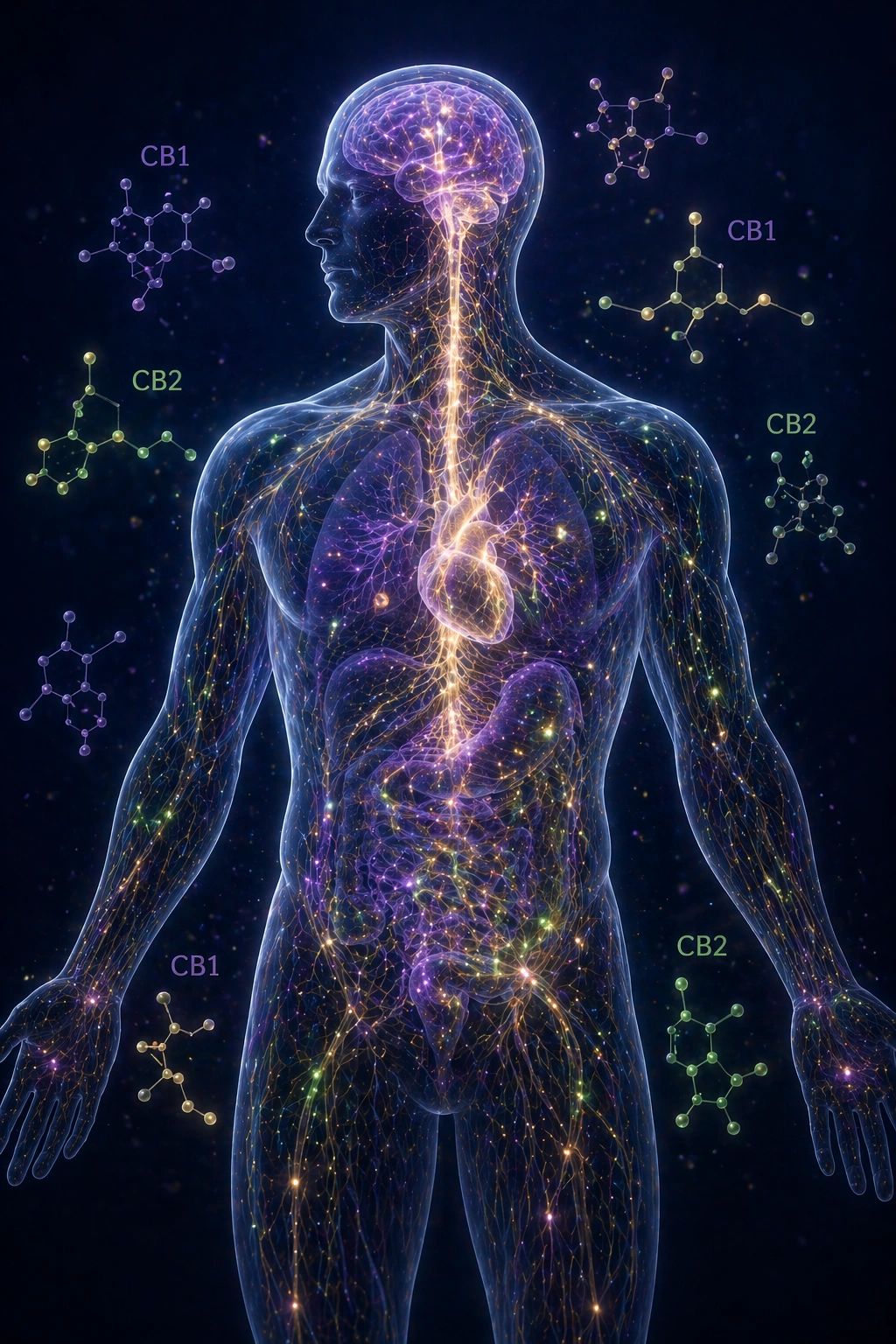
CB1 receptors are found predominantly in the central nervous system, meaning the brain and spinal cord. They are also present in peripheral nervous tissue and in several organs. CB1 receptors are the receptors that THC binds to most effectively, and this binding is responsible for the psychoactive effects associated with cannabis. When THC attaches to CB1 receptors in the brain, it mimics the action of anandamide but does so more powerfully and for longer, which is why the effects of THC are more pronounced and longer-lasting than the natural endocannabinoid it resembles.
CB2 receptors are found primarily in the immune system, the peripheral nervous system, and in organs throughout the body including the gut, the liver, and the spleen. CB2 receptors are particularly relevant to inflammation and immune response. CBD does not bind directly to CB2 receptors the way THC binds to CB1, but it influences CB2 receptor activity indirectly, which is one of the mechanisms behind CBD's documented anti-inflammatory properties. Interestingly, the terpene caryophyllene, which is found in black pepper, cloves, and many cannabis strains, is the only known terpene that binds directly to CB2 receptors, making it technically a dietary cannabinoid as well as a terpene.
How THC Interacts with the Endocannabinoid System
THC, which stands for delta-9-tetrahydrocannabinol, is the primary psychoactive compound in cannabis, and it produces its effects almost entirely through its relationship with CB1 receptors. THC is structurally similar enough to anandamide that it fits into CB1 receptors and activates them, but it does so more intensely and for a much longer period than anandamide naturally would because the body's enzymes have a harder time breaking THC down quickly.
When THC activates CB1 receptors in the brain it produces a cascade of effects that include altered sensory perception, changes in time perception, increased appetite, reduced nausea, pain relief, and in many users euphoria and relaxation. In some users, particularly those who are sensitive to THC or who consume high doses, CB1 activation can also produce anxiety, paranoia, and short-term memory disruption. This is why dose control matters enormously with THC and why the individual sensitivity of a person's CB1 receptor density and baseline endocannabinoid levels plays such a significant role in determining how someone experiences THC.
How CBD Interacts with the Endocannabinoid System
CBD, or cannabidiol, interacts with the endocannabinoid system in a fundamentally different way than THC, which is why it does not produce psychoactive effects. Rather than binding directly to CB1 receptors the way THC does, CBD works through a more indirect and nuanced set of mechanisms that researchers are still actively studying and mapping.
One of CBD's primary actions is inhibiting the enzymes responsible for breaking down anandamide, which means CBD effectively increases the amount of your body's own natural endocannabinoids circulating in the system. Rather than introducing a foreign psychoactive compound, CBD helps the body use more of what it is already producing. This is one of the reasons CBD is associated with mood support, anxiety reduction, and general wellness effects without the intoxication associated with THC.
CBD also interacts with several receptor systems outside of the endocannabinoid system itself, including serotonin receptors which are involved in mood and anxiety, vanilloid receptors which are involved in pain and inflammation perception, and GPR55 receptors which are studied in the context of bone density and metabolic function. This broad receptor activity is part of why CBD has such a wide range of reported wellness applications across so many different body systems and conditions.
The Entourage Effect: Why the Whole Plant Matters
One of the most important concepts in endocannabinoid system science is the entourage effect, and understanding it changes how most people think about cannabis products and what to look for when choosing them.
The entourage effect refers to the synergistic interaction between the full range of compounds found in the cannabis plant, including cannabinoids like THC and CBD, minor cannabinoids like CBG and CBN, and terpenes like myrcene, limonene, and caryophyllene. Research suggests that these compounds work more effectively together than any single compound does in isolation because they interact with overlapping receptor systems in ways that amplify or modulate each other's effects.
This is why full-spectrum cannabis products, which contain the complete range of naturally occurring plant compounds, are generally considered more therapeutically effective by many researchers and experienced users than isolate products, which contain only a single extracted cannabinoid. It is also why the terpene profile of a cannabis product matters beyond just aroma. Terpenes are not passive flavor compounds. They are biologically active molecules that interact with the endocannabinoid system and other receptor systems in ways that meaningfully shape the overall experience and effect of a cannabis product.
What Happens When the Endocannabinoid System Is Out of Balance
Some researchers have proposed a concept called clinical endocannabinoid deficiency, which suggests that insufficient endocannabinoid system function may underlie certain chronic conditions that are difficult to treat through conventional medicine. Conditions that have been explored in this context include migraine, fibromyalgia, and irritable bowel syndrome, all of which share characteristics of central sensitization and have responded in patient reports and some clinical studies to cannabis-based approaches.
While clinical endocannabinoid deficiency remains a theoretical framework rather than an established diagnosis, the underlying logic is scientifically coherent. If the endocannabinoid system is responsible for regulating pain, mood, sleep, and immune function, then a system that is underperforming could plausibly contribute to conditions characterized by dysregulation in exactly those areas. Cannabis, by interacting with and supporting this system, may help restore some of that regulatory capacity.
Why This Matters for Every Cannabis Consumer
Understanding the endocannabinoid system transforms the way you approach cannabis as a consumer. Instead of choosing products based on whether they are labeled sativa or indica, or based on THC percentage alone, you begin to understand that what you are really doing when you consume cannabis is having a conversation with your own biology. The compounds in the plant are speaking directly to a system in your body that exists specifically to receive and respond to them.
This understanding helps you make better product choices, have more productive conversations with your budtender and your healthcare provider, understand why certain products work for you and others do not, and approach cannabis as the genuinely complex wellness tool it is rather than a simple recreational substance.
The endocannabinoid system is not a cannabis discovery. It is a human discovery that cannabis helped reveal. And understanding it is the first real step toward using cannabis with genuine intention and intelligence.
Visit our Learn section at geniusbuds.com/learn for more science-backed cannabis education built for every kind of consumer.
This article is for educational purposes only and does not constitute medical advice. Always consult a licensed healthcare professional before making any health or wellness decisions.